07906 376342


Episode 2 of my Edge of the Hedge podcast has been published this week.
It’s called ‘Mallows and Purple Hedgerows’, and takes you on an audio walk with me, along a small section of the Viking Way in Lincolnshire, on a baking hot day at the end of July. We take a look at the Common Mallow (Malva sylvestris), as well as noticing some of the other purple flowers in the hedgerows at this time of year, such as Black Horehound (Ballota nigra) and this various Thistles.
You can read the show notes right here, just under the podcast player below.
You can subscribe and listen wherever you listen to your podcast, including Apple Podcasts, Spotify, Amazon Music, Stitcher, Google Podcasts and more. If you enjoy, it would be really lovely if you could leave me a rating and / or review. It’s also available to listen to on my Edge of the Hedge podcast web page.
Here are the shownotes to accompany the podcast for this month. Enjoy!
Ahhh, the Common Mallow. What an unsung bright purple beauty of the summer hedgerow.
Right now, it’s thriving, and will continue to do so for another few months, right into October, all being well.
You’ll find the Common Mallow, across the UK, although as sources report, somewhat lesser so in the northern reaches of Scotland. It also thrives across Europe and into northern Africa.
You’ll find the Common Mallow either growing straight upright, with its tough, round stalks reaching anything up to about a meter and half tall, or sprawling straggly under and over hedgerows and wasteland. Quite commonly, especially where green growth is cut back often, you’ll even see it appear like a small pavement or footpath posy.
The petals of this Mallow is where the French derived the name of the colour ‘mauve’ from. 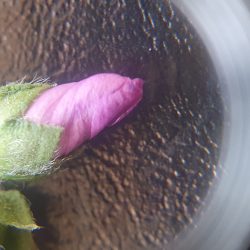
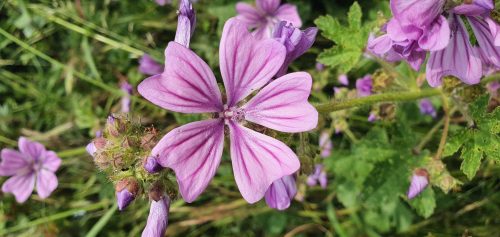
These flowers sprout from the stem in clusters of three or four, and emerge from tightly wrapped cone-like buds of purple. Each flower has five separate pinkish-purplish, very delicate petals, almost long-heart-shaped, or ‘notched’ as they’re usually described. Along each petal are darker threads of veins, often 3 or 4 prominent ones, with thinner ones branching off, striping from the base of each petal up towards the top edges of the petal, fading as they reach the perimeter. Then right in the middle of each flower is a delicately showy – if you look closely enough – bunch of stamens sticking out from the centre.
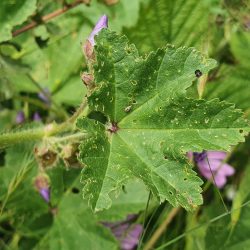
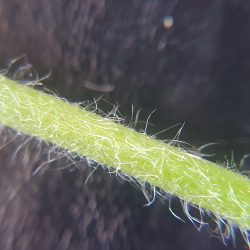
Its leaves are somewhat crinkly, and fan-like, spreading out, like the palm of a hand into usually five lobed – palmately lobed, if you will, but not especially hairy, unlike other members of the family, like the marshmallow – which is so delicate hairy and soft, it’s like stroking the ears of a small animal.
Interestingly, when the flower goes to fruit, to seed, it forms into rounds of sharp-edged discs – think of a flatter ‘Chocolate Orange’ or Trivial Pursuits ‘cheese / pie’ wheel. The 16th Century herbalist John Gerard noted this, when he described these fruits as ‘rounde and flat, made lyke little cheeses’. It’s this shape that that continued to give rise to many of the historical local names for Common Mallow – such as ‘Billy Button’ (Somerset), Cheese flower (Yorkshire), Fairy cheeses (Lincolnshire), Lady’s Cheese (Donegal), although quite where my personal favourite old name Flibberty Gibbet (Yorkshire) comes into this, I have no idea!
Archaeological evidence suggests that mallows were in existence, and used medically 8000 years ago. Other sources tell us that it’s thought to have arrived here in the UK with the Romans, who planted it for food and medicine. They are hardy. They’re survivors. It thrives on bare ground, waste ground and roadsides and in our hedgerows and urban areas, where it’s permitted to thrive and not seen as a
weed. It doesn’t need special care or fancy feeds. It returns, as a perennial, year after year.
Here in Lincolnshire, according to The Flora of Lincolnshire, a publication from the mid 1970s, by the Lincolnshire Naturalist’s Union, our first official botanical recording of the Common Mallow was in 1790, in Threckingham (or Threekingham as it is now know), in the south of the county. There it notes it’s prevalence on waste places and roadsides too. It mentions other mallows too, such as a Musk Mallow, although I have to admit, I’ve never seen any of the others that it notes, whilst on my travels.
Common Mallow is known in botanical Latin as Malva sylvestris. Depending on which source you read, the name ‘Malva’ is said to derive from the Old English ‘malwe’ but also ‘moloche’ meaning softening. There is also some link to the word ‘mellow’.
Mallow by its own nature, is soft, and mellow. There’s an onomatopoeic quality to the word ‘mallow’ too, isn’t there? It just sounds soft and gentle.
Then there’s the second part of its Latin name ‘sylvestris’, which is derived from the Latin ‘silva’ meaning wood, or forest. ‘Of the forest’ as it is often translated. Botanically, it is sometimes used to just mean ‘wild’. I have to say, I rather like the ‘of the forest’ etymology of ‘sylvestris’, with my surname being as it is. It conjures up images of my ancestors being folk of the words. That would sit comfortably with me, being as fond of trees as I am.
The Common Mallow sits within a botanical family of its own naming – the Malvaceae family, which also comprises the vegetable Okra, Hollyhocks as well as the Linden / Lime tree, as featured in Episode One of Edge of the Hedge. All the plants and trees in this family share common features, in terms of their leaf and flower appearance.
Somewhat more famously, but often forgotten, is another member of this family – the Marsh Mallow (Althaea officinalis). As the name would suggest, this is fond of soggy marsh lands, and so certainly historically in the wild, this is where you would find it. Now, it’s rarely found in the wild, but easy to cultivate, and like it’s relative is just as resilient and bounces back from even the most changeable conditions (or lack of watering!). It’s the root of this plant that formed the basis for… the Marshmallow sweet. Yes, those sticky, gooey, light, squidgy sweets that can be found toasted over campfires and chomped on by children and adults alike, were once made from this plant. Although now in the present day, our shop-bought Marshmallows haven’t even had so much of a piece of the real plant waved at them, let alone included as an ingredient.
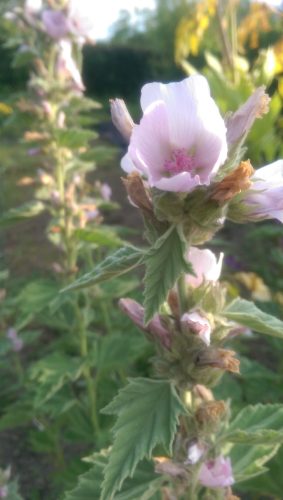
MARSH MALLOW – Althaea officinalis
Whilst the Marsh Mallow (Althaea officinalis) is more lauded for its medicinal qualities, (hence it is the ‘official’ mallow), of which it holds plenty, and is why herbalists will most commonly use this over the Common Mallow, it is important to remember and consider the Common Mallow’s place in our medical history.
It doesn’t take too much delving into historical collections to find mention of the leaf being used as a poultice for stiff joints and sprains in Ireland. There are records from Wales, giving praise for its ability, when used in a poultice to cure sprains of horses’ legs and swellings and sores on animals. In Sussex, it was used in the home as a cure for cuts. There is even a tale recounted from Worcestershire of someone’s foot, after being pierced by an upturned nail, being treated with “mallow on the wound, which healed beautifully”.
It’s the chemistry of this plant that makes it so valuable, medicinally. It contains ‘mucilage’ – kind of sounds like ‘mucus’, doesn’t it? Mucilages are sweet, soothing, sticky, healing chemicals. We now know that the Common Mallow, the flower have around 10% mucilate, and the leaves 7%. Marsh Mallow (Althaea officinalis) contains much more than this, hence its more common use, amongst herbalists.
Mucilages are cooling and moistening, so are useful to counterbalance body states that are ‘hot’ and ‘dry’. This is why herbalists will use Marsh Mallow leaf for dry coughs (as they are slightly expectorant too), and mild urinary tract infections.
There are herbalists who have more recently used the Common Mallow leaf, on the skin as a poultice, to relieve swellings, small cuts, and insect botes. I myself am yet to try it. But as someone who is regular food for summer insects, I pledge to give it a try this summer!
Mallow flowers are edible in small to moderate quantities (they’re problematic for the digestion in larger amounts, due to having a laxative quality), and can be added to salad, cakes or just nibbled on as a wayside snack. And the flowers make a wonderful expectorant infusion too.
Sources:
Barker, J. (2001) The Medicinal Flora of Britain and Northwestern Europe. West Wickham: Winter Press.
Blamey, M., Fitter, R. and Fitter, A. (2003) Wild Flowers of Britain and Ireland. London: A & C Black Publishers.
Bruton Seal, J. and Seal, M. (2008) Hedgerow Medicine: Harvest and Make your Own Herbal Remedies. Ludlow: Merlin Unwin.
Gibbons, E. J. (1975) The Flora of Lincolnshire. Lincoln: Keyworth and Fry.
Grigson, G. (1996) The Englishman’s Flora. Oxford: Helicon Publishing.
Hatfield, G. (2007) Hatfield’s Herbal: The Secret History of British Plants. London: Allen Lane.
Mabey, R. (2007) Food for Free. London: Harper Collins
Rose, F. (2006) The Wild Flower Key: How to identify wild flowers, trees and shrubs in Britain and Ireland. London: Frederick Warne.
The Wildlife Trusts (n.d.) Common mallow [online] Newark: The Wildlife Trusts. Available from https://www.wildlifetrusts.org/wildlife-explorer/wildflowers/common-mallow [Accessed 20 July 2021].
Tobyn, G., Denham, A., and Whitelegg, M. (2011) The Western Herbal Tradition: 2000 Years of Medicinal Plant Knowledge. Edinburgh: Churchill Livingstone.
Vickery, R. (1995) A Dictionary of Plant Lore. Oxford: Oxford University Press.