07906 376342


Where it likes to grow:
On lawns, footpaths, roadsides and waste ground – likely anywhere it can be ‘downtrodden’.
What does Plantain look like?
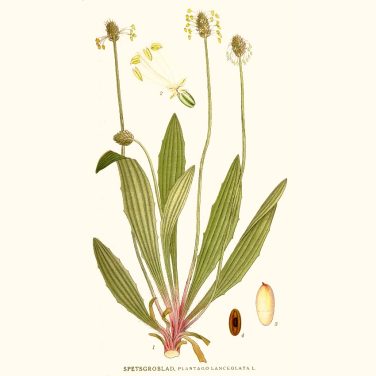
Deep green, long lanceolate (spear-shaped), ribbed leaves, that grow in a rosette, pointing upwards. The stalks are straight and the spike flowers are wind-pollinated. The leaves are said to resemble a footprint.
When to gather Plantain, and what parts of the plant to use:
The leaves, in the spring / summer when they look healthy and green, best between May and August.
It is a little difficult to dry as it has a tendency to blacken and mould easily, so spread them on brown paper and allow to dry completely before chopping and storing for dried infusion-use.
Is Plantain safe?
It’s generally safe externally, and internally.
What can you make with Ribwort Plantain?
Wound plaster – The shape lends itself to be used as a plaster, and it also benefits wounds as it contains constituents that acts as a wound germ-killer and disinfectant, reduces inflammation and speeds up the healing process. Fresh leaves are better for this. It’s also great as a first aid remedy for insect bites, if you rub a leaf on the bite, releasing leaf juice directly onto the bite. You can chew or crush the leaf to make it more malleable before you apply to the skin.
Infused oil – You can also make an infused oil, and use it on the skin to relieve itchy skin (steep them in sunflower oil for a couple of weeks).
Infusion / herbal tea – It can also be used as a lung remedy, to relieve irritated lung mucous membrane and ease coughing and breathing – so can be helpful to relieve symptoms of hay fever and mild asthma. It’s said that heavy smokers may benefit from drinking Plantago tea to help strengthen and restore lung tissue. Chronic bronchitis may also benefit from the pant, as it helps to ‘bring up’ old, stuck phlegm. For an infusion, a heaped teaspoon of leaf (fresh or dry), with boiling water poured over the top, and steeped for 10 minutes will make a good brew. 3 mugs a day is usually recommended.
References:
Image: http://commons.wikimedia.org/wiki/File:127_Plantago_lanceolata.jpg
‘Complete Earth Medicine Handbook’ by Susanne Fischer-Rizzi
‘Hedgerow Medicine’ by Julie Bruton-Seal and Matthew Seal
‘Herbal poultices, compresses and inhalations’ – lecture by C.Acott, 2008, University of Lincoln